
When war breaks out, every market reacts. Stocks crash, oil spikes, gold surges but what about war crypto? In 2026, with the US-Israel-Iran conflict reshaping global markets, Bitcoin’s behavior during wartime is finally being put to the ultimate test.
Here’s everything you need to know.
How Crypto Reacts When War Starts
The pattern is becoming familiar. Each time a major conflict erupts, Bitcoin follows the same script:
- Immediate drop — panic selling as traders flee risk assets
- Quick rebound — opportunistic buyers step in
- Long-term uncertainty — tied to how long the war lasts
When the US struck Iran in late February 2026, Bitcoin dropped from $68,000 to nearly $63,000 over a single weekend. Within 48 hours, it clawed back above $69,000. The same pattern played out during the Russia-Ukraine war in 2022 and the October 2023 Middle East escalation.
War crypto lesson #1: The first 72 hours are always chaotic. Then the market finds its footing.
Is Bitcoin “Digital Gold” During Wartime? Not Really.
The crypto community has long pushed the narrative that Bitcoin is a safe haven the “digital gold” of the modern era. But war is exposing the limits of that story.
In 2026, Bitcoin’s correlation with the Nasdaq hit 0.75, while its correlation with actual gold turned negative (-0.27). Translation: when conflict starts, institutions sell Bitcoin to cover equity losses and buy physical gold as a hedge.
Bitcoin behaves more like a high-beta tech stock than a safe haven asset during active military operations.
Gold in 2026: Record highs above $5,500. Bitcoin in 2026: Struggling to hold $70,000 under war pressure.
War crypto lesson #2: If you want a true wartime hedge, gold still wins. Bitcoin is not there yet.
Where Bitcoin Actually Shines in Wartime
Despite failing the “digital gold” test, crypto proves incredibly useful in conflict zones just not in the way markets expect.
1. Sanctions Bypass
Iran has been using crypto for years to sidestep US financial sanctions. Blockchain analytics firm Chainalysis reported that Iran-linked entities moved over $2 billion through crypto channels for arms procurement, oil sales, and money laundering. War crypto is a lifeline for sanctioned economies.
2. Refugee Finance
When people flee war zones, they can’t carry their bank accounts. Crypto wallets travel with you. During the Ukraine conflict, millions of refugees relied on digital assets to preserve and transfer wealth across borders.
3. 24/7 Liquidity
Traditional markets close on weekends. Crypto doesn’t. When US-Israel airstrikes hit Iran on a Saturday night, Bitcoin was the only major “market” open for price discovery. Traders used it to express macro views, hedge positions, and rotate capital all before Wall Street opened Monday morning.
War crypto lesson #3: Crypto’s true wartime value is in utility, not speculation.
The New Threat: BRICS CBDCs vs. The Dollar
The 2026 conflict has accelerated something even bigger than Bitcoin’s price moves. The BRICS bloc led by India’s 2026 chairship is pushing a CBDC bridge framework designed to bypass the US dollar entirely.
If successful, this would represent the most serious challenge to dollar dominance since Bretton Woods. And it’s happening right now, in parallel with a shooting war.
What this means for war crypto:
- Demand for non-Western, decentralized assets could surge
- Bitcoin may eventually benefit from de-dollarization trends
- The race between state CBDCs and decentralized crypto is accelerating
3 Cryptos to Watch During the 2026 War Cycle
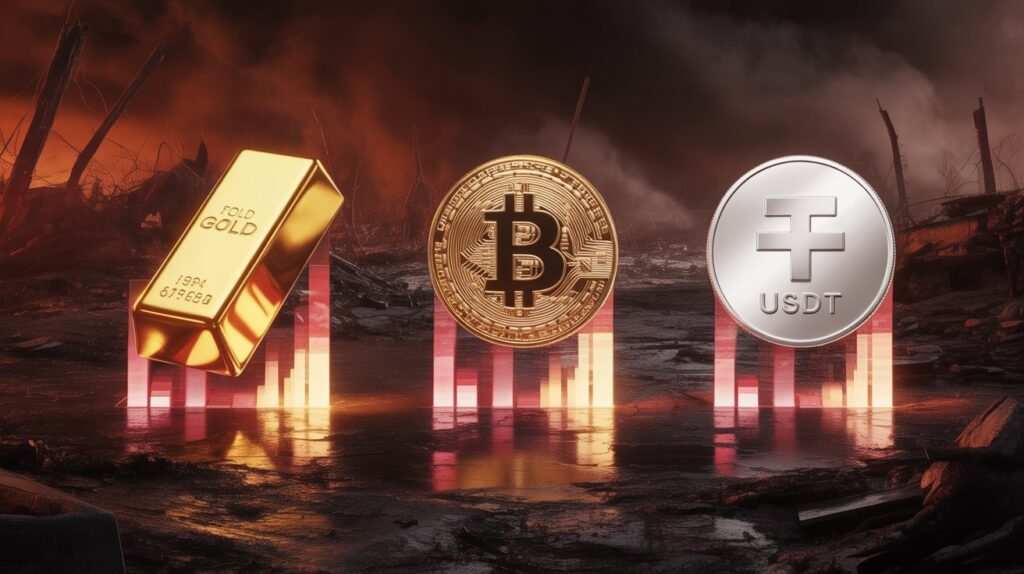
🥇 Bitcoin (BTC)
The benchmark. Volatile short-term, but institutional ETF inflows during war dips suggest smart money is treating pullbacks as buying opportunities.
🥈 Gold-Backed Tokens (PAXG, XAUT)
The hybrid play. Combines crypto’s accessibility with gold’s safe-haven status. Gaining traction in war scenarios.
🥉 Stablecoins (USDT, USDC)
The practical choice. Refugees, sanctioned nations, and anyone needing to move money fast without FX exposure. War crypto at its most functional.
What Happens If the War Drags On?
Market analysts are watching the Strait of Hormuz closely. If Iran closes it, oil prices could spike past $120/barrel triggering an inflation shock that would:
- Push the Fed to keep rates high
- Crush risk assets including crypto
- Send gold even higher
Arthur Hayes, co-founder of Maelstrom, put it bluntly: “Global markets are not fully pricing in a longer war between the US and Iran.”
If he’s right, war crypto volatility is just getting started.
Key Takeaways
| Scenario | Bitcoin Impact |
|---|---|
| Short war, quick resolution | Bullish relief rally |
| Extended conflict | Bearish inflation pressure |
| Sanctions escalation | Mixed utility up, price volatile |
| BRICS de-dollarization | Long-term bullish |
Conclusion
War crypto is no longer a theoretical concept it’s playing out in real time in 2026. Bitcoin is neither the digital gold its fans claim, nor the worthless speculative asset its critics mock. It’s something more nuanced: a 24/7 liquidity layer, a sanctions workaround, and a geopolitical barometer.
As the US-Iran conflict evolves, one thing is certain: crypto won’t sit this one out.
Written by coispoltech | March 2026 | Tags: war crypto, bitcoin war 2026, crypto geopolitical risk, Iran conflict cryptocurrency, war currency
 Bitcoin
  Ethereum
  Tether
  BNB
BNB  XRP
XRP  USDC
USDC  Solana
  TRON
TRON  Lido Staked Ether
  Figure Heloc